Photovoltaic (PV) encapsulant
Mitsui Chemicals Group began selling EVA for photovoltaic (PV) cell encapsulant in 1983. After that, we began selling POE (polyolefin resin), TAFMER™, for solar cell encapsulant, and in 2012 we launched polyolefin based encapsulant. Our activity also encompasses the ownership of PV power generation facilities, and the implementation of Diagnostics and Consulting Business for Photovoltaic Power Generation.
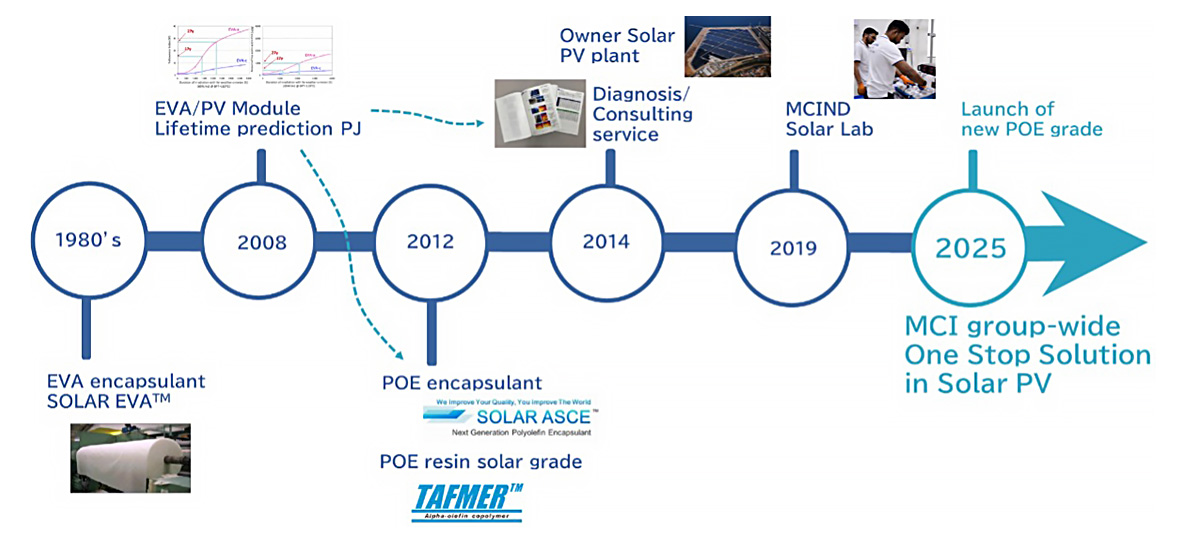
Our group's strength lies in such accumulation of years of experience and data. Since the Mitsui Chemicals Group manufactures and sells not only POE for PV cell encapsulants but PV cell encapsulant sheets, we can develop from raw material resin to encapsulant sheets in a comprehensive way. Our group has been and will continue to work on the development of innovative encapsulation sheets and their raw material resins.
Features of TAFMER™ designed for PV encapsulants
1. No free acid
TAFMER™ designed for PV encapsulants, is an ethylene alpha olefin copolymer. EVA, a copolymer of ethylene and vinyl acetate, is generally used for PV encapsulants. The free acid generated by decomposition of EVA, however, can cause corrosion of the wires and/or electrodes of PV modules. TAFMER™ does not generate such acid and contributes to the high durability of PV modules.
2. High light transmittance
TAFMER™ designed for PV encapsulants has high light transmittance and contributes to higher efficiency of PV module.
3. High volume resistivity
TAFMER™ designed for PV encapsulants has higher volume resistivity than EVA and conventional POE. The high volume resistivity suppresses PID (Potential Induced Degradation), and improves the durability of PV module.
Intellectual property status of our group in the solar cell encapsulant
Mitsui Chemicals Group currently holds multiple patents in the PV encapsulant field. As we are aware of the globalized market for PV, we hold Intellectual Property in many locations.
From our group’s patent lineup, the following are examples of IPs related to PV encapsulants.
These patents are regarding PV modules and/or PV encapsulants using POE resin with specific characteristics.
Mitsui Chemicals Group is committed to protecting and strengthening intellectual property rights to enhance corporate value.
| International publication No. | WO2012/046456 | WO2012/060086 | WO2013/145602 |
|---|---|---|---|
| patent family (November 2025) |
CN103140940B EP2993704B1 JP05016153B2 JP05889709B2 KR1460464B1 US8772625B2 TWI550005B MX340497B MX396877B MY-161007-A PH12013500422B1 TH97723B |
CN103189996B JP05483646B JP05877593B2 KR1493183B1 US9349895B2 TWI592430B MY-170295-A PH12013500834B1 TH95071B |
CN104247042B EP2833415B1 JP05830600B2 KR1617573B1 US9865752B2 TWI606068B SG11201406117B |
EP 2993704B1 was opposed, and the EPO’s Opposition Division has maintained the patent in amended form.
EP 2833415B1 was opposed before the EPO, and filed an appeal. The EPO’s Board of Appeal has maintained the patent in amended form.