
Through these means, the Mitsui Chemicals Group recognizes that it is better placed to achieve sustainable growth and increased corporate value over the medium to long term.
Accordingly, Mitsui Chemicals positions efforts to upgrade and expand its corporate governance as a key management issue and will persevere with the efforts outlined above.
日本語
English
Corporate Governance
Our Approach to Corporate Governance
The Mitsui Chemicals Group is constantly engaged in business activities to realize its Corporate Vision, which comprises a Corporate Mission and a Corporate Target. The Group recognizes efforts to achieve effective corporate governance as part of the process that will allow us to:
- Maintain and develop trusting relationships with its shareholders and all other diverse stakeholders of the Mitsui Chemicals Group, and
- Create a framework that can execute transparent, fair, timely, and decisive decision making.
Corporate Vision
Corporate Mission
Contribute broadly to society by providing high-quality products and services to customers through innovations and the creation of materials, while keeping in harmony with the global environment.
【Five social contribution areas】
- Promoting human well-being
- Contributing to the value of shareholders’ investments
- Increasing customer satisfaction
- Contributing to local communities
- Promoting the happiness and fulfillment of employees
Corporate Target
To be a corporate group that continues to grow
through solving social challenges and creating diverse value
with the power of chemistry
Publicly released since the fiscal year ended March 31, 2016, the Mitsui Chemicals Group Corporate Governance Guidelines outline the Group's fundamental policies and efforts in relation to corporate governance.
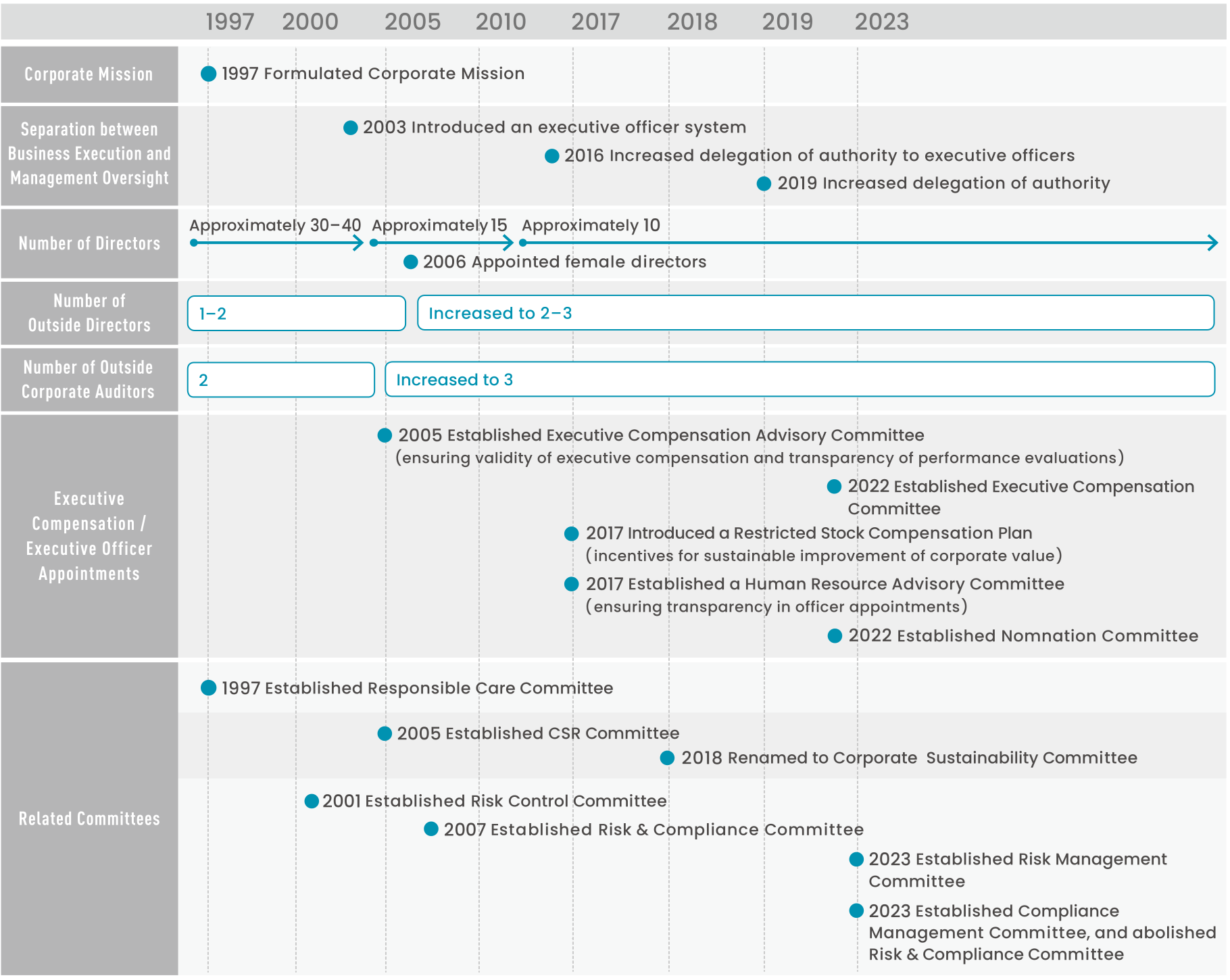
History of Corporate Governance Reforms
We have continuously instituted reforms since the founding of the Mitsui Chemicals with the aim of raising the effectiveness of our corporate governance to an even higher level.
Corporate Governance Framework
At the Mitsui Chemicals, the Board of Directors including Outside Member of the board independent of business execution makes material management decisions and supervises the execution of duties by each member of the board and the duties of other executive officers, etc. As a company with a Board of Corporate Auditors, the status of each member of the board’s performance of his or her duties is audited by the corporate auditors and the Board of Corporate Auditors independently from the Board of Directors.
Within this framework, the Company strives to realize smooth and efficient management, undertaking initiatives aimed at, for example, clarifying official authority and decision-making procedures in light of Company rules, clarifying management supervision and business execution roles by introducing an executive officer system, ensuring that important matters are referred to the Management Committee for discussion, and ensuring a broad range of perspectives inform strategic discussions undertaken at the Group-wide Strategy Commitee. In addition, as part of its internal control system the Company’s corporate auditors conduct audits to ensure the propriety of business operations while the Internal Control Division works to ensure sound risk management.
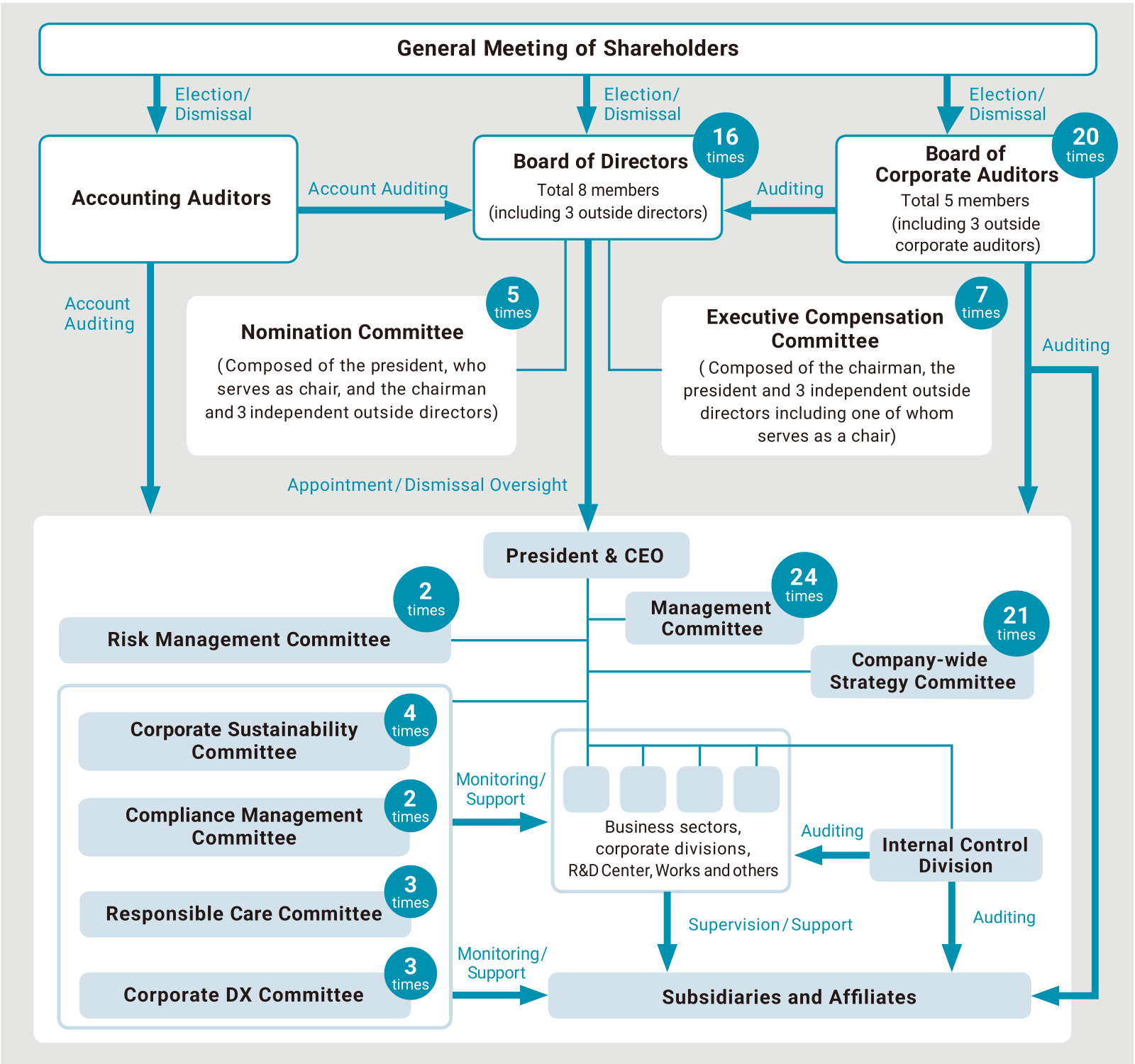
*● Number of meetings held in fiscal 2024.
The General Meeting of Shareholders makes important decisions as the supreme decision-making body of the Company while being a valuable venue for direct and constructive dialogue with shareholders.
The Board of Directors decides business strategies, business plans, and all other important matters related to management. The Board also oversees the overall management of the Group through reporting on such matters as the performance and duties of individual directors, important operations of subsidiaries and affiliates, and the implementation status of compliance and risk management systems by the Company and its subsidiaries and affiliates.
Moreover, the Board of Directors deliberates important corporate management policies from the intermediate stage and takes steps to reinforce management supervisory functions by providing advice to executives.
Corporate auditors conduct audits on such matters as the directors’ performance of duties in accordance with audit policies and plans established by the Board of Corporate Auditors.
Corporate auditors, the accounting auditor, and the Internal Control Division (Mitsui Chemicals’ internal audit department) mutually cooperate to conduct audits by reporting each annual plan, audit results, and all other relevant information by exchanging opinions and information among themselves while taking into account the independence of each audit.
To ensure the transparency and the validity of executive officer appointments, the Company has established the Nomination Committee as a consultative body of the Board of Directors as well as a mechanism to determine the system for proposing executive officer candidates.
To ensure the transparency of performance evaluations and the validity of the compensation levels, the Company has established the Executive Compensation Committee as a consultative body of the Board of Directors as well as a mechanism to determine the system of executive compensation and evaluate the performance of directors.
To ensure appropriate and efficient decision making, the Company has established the Management Committee to review items that need to be discussed in advance of being put on the agenda of Board of Directors meetings and to deliberate on important matters related to business execution.
The Company has established the Group-wide Strategy Committee to deliberate on strategy from a Company-wide perspective related to management and operational issues.
The Company has established various types of committees to assist in enhancing its corporate governance.
- Risk Management Committee
The Risk Management Committee (chaired by the President) was established to ensure implementation of risk management. The Committee deliberates on the basic policies, strategies, and plans for risk management across the Group. Furthermore, the Committee deliberates on the selection and prioritization of key risks across the Group through enterprise-wide risk reviews as well as the responses to individual key risks. The results of the Committee’s deliberations and activities are reported to the Management Committee, and proposals on key risks across the Group are discussed at the Committee, and following the Management Committee determined by resolution of the Board of Directors. The Committee commenced operations in fiscal year of 2023.
- Corporate Sustainability Committee
The Corporate Sustainability Committee deliberates on the MCI Group’s groupwide policies, strategies, and plans for promoting ESG. We are aiming for the sustainable development of both society as a whole and the MCI Group. To that end, we are addressing the ESG-related challenges identified in the sustainable development goals (SDGs) and elsewhere by seeking out business opportunities in order to resolve issues through its business activities, as well as recognizing and tackling future risks for the MCI Group, and fulfilling its social responsibility as a company.
- Compliance Management Committee
The Compliance Management Committee (chaired by the Responsible officer for the Corporate Administration & Legal Division) has been established to promote compliance management across the Group. The Committee determines annual plans and policies related to compliance management, and implements measures related to compliance (prevention, detection, initial and permanent responses, and measures to raise awareness). The Committee commenced operations in fiscal year of 2023.
- Responsible Care Committee
Responsible Care (RC) activities span the entire life cycle of each chemical product, from development and manufacturing to transport, use, consumption and disposal, and are aimed at protecting the environment, ensuring process safety and disaster prevention, chemical safety, and maintaining occupational health and quality. To that end, the Company has established the Responsible Care Committee (chaired by the executive officer in charge) as a separate entity from the Corporate Sustainability Committee. The Responsible Care Committee deliberates on policies, strategies, plans and evaluates the performance of RC-related activities. In fiscal 2016, the Committee convened three meetings. Important policies, strategies and plans proposed by the Responsible Care Committee are approved by the Management Committee.
Corporate Auditor System and the Status of Audits
As being independent from the Board of Directors, corporate auditors have conducted audits on such matters as the members of the board’s performance of duties, internal corporate control, business performance, and financial status through such means pursuant to law and ordinance as requesting reports on MCI’s businesses, exercising its authority in the election and dismissal of accounting auditors, and investigating the status of operations and assets. Specifically, the fulltime corporate auditors attend not only the meetings of the Board of Directors but important meetings of MCI such as Management Committee, in addition to have regular meetings with the president and others to exchange opinions. They also officially receive and check the final-decision documents of executive directors and records of important meetings and hear reports and explanations from each division. In addition, the corporate auditor audits are attended by three outside corporate auditors, as necessary, who make statements based on their extensive experience and broad knowledge. Outside Corporate Auditor SHINBO Katsuyoshi had accumulated extensive experience over many years as an attorney-at-law and possessed substantial expertise in compliance and risk management. (Mr. SHINBO stepped down from his position due to his passing on February 8, 2025.)
Outside Corporate Auditor GOTOH Yasuko has been widely experienced as a manager and CFO of a listed company and has extensive knowledge and insights on finance and accounting. Outside Corporate Auditor ONO Junshi has been widely experienced as a certified public accountant for many years and has extensive knowledge and insights on finance and accounting. The Board of Corporate Auditors met on 20 occasions in fiscal year of 2024, with particular audit focus on the following matters:
- initiatives to achieve VISION 2030
- Initiatives and challenges related to business process reforms
- Matters of concern and response status regarding risk management and compliance
Furthermore, meetings of the Board of Corporate Auditors are, in principle, held once a month, and attendance and key matters for consideration for each corporate auditor in fiscal 2024 are as follows.
| Name | Attendance | Key matters for consideration | |
|---|---|---|---|
| the full-time corporate auditors | NISHIO Hiroshi | 20/20 | Including matters related to the operational status of the corporate governance structure as disclosed in the Annual Securities Report, the Board of Corporate Auditors reviewed a total of 87 items, comprising 9 resolution items, 27 discussion items, and 51 reporting items, and examined the status of the internal control system, the execution of duties by Directors, and the evaluation and reappointment of the accounting auditor. |
HOSOMI Yasuhiro | 20/20 | ||
| the outside corporate auditors | SHINBO Katsuyoshi | 12/15 | |
| GOTOH Yasuko | 19/20 | ||
| ONO Junshi | 13/13 | ||
MCI has established the Internal Control Division as an internal organization consisting of 20 members. Based on the yearly audit plan discussed and formulated in advance at Management Committee, the division audits the accounts and business of the Mitsui Chemicals Group, including affiliated companies, and reports the results to the Board of Directors, the Board of Corporate Auditors and the Management Committee.
Furthermore, corporate auditors also exchange opinions with accounting auditors and the Internal Control Division regarding annual audit plans and audit results, and coordinate with one another and conduct audits, whilst ensuring that their respective auditing activities remain independent.
When necessary, MCI’s corporate auditors conduct audits of affiliated companies based on the results of audits by the Internal Control Division and each company’s corporate auditors, and they also exchange information and otherwise coordinate with each company’s corporate auditors.
Evaluation of the Effectiveness of the Board of Directors
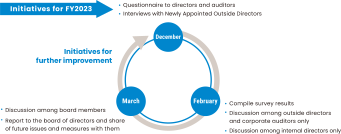
The Company’s Board of Directors strives to improve its meetings by analyzing and evaluating the effectiveness of the Board as a whole every year using such methods as self-evaluations performed by directors and corporate auditors, and discussions only among outside directors and outside corporate auditors.
| Method for evaluating the effectiveness of the Board of Directors in fiscal year of 2024 |
|---|
 |
| Measures taken in fiscal 2024 |
|---|
① Selection of meeting agenda for the Board of Directors We timely and appropriately selected strategic and governancerelated agenda items, such as the revision of financial targets in line with the progress of VISION 2030, the restructuring of subsidiaries and affiliates, and discussions on key M&A projects. |
② Improvement of the operation of the Board of Directors to deepen discussions on the day of a meeting We provided information to deepen understanding of agenda items by outside directors and outside Audit & Supervisory Board Members by holding multiple pre-briefing sessions depending on the importance of the agenda, and through visits to overseas sites related to the agenda. We also arranged opportunities for free discussion among outside directors and outside Audit & Supervisory Board Members, where issues related to operations of the Board of Directors, M&A, and DX were shared. |
③ Improvement of reports on the operation of our internal control system We revised the reporting format for internal control system operations, which had previously been presented separately by each responsible committee (the Risk Management Committee, Compliance Management Committee, and Corporate Sustainability Committee, etc.) at different times. Now, the heads of each committee report sequentially at the same meeting of the Board of Directors, enabling the members of the Board of Directors to grasp the overall structure of the internal control system and engage in deeper discussions. |
| Evaluation results and future initiatives |
|---|
The directors’ and corporate auditors’ self-evaluation scores of fiscal 2024 were on a par with those of the previous fiscal year on the whole. The company has also confirmed that progress for the improvement has been accelerated by having taken measures aligned with the objective of reinforcing the supervisory functions of the Board of Directors, and accordingly finds that the effectiveness of the Board of Directors is sufficiently ensured, as being carried on from the previous fiscal year. |
Future challenges
(1) Further improvement of risk management monitoring functions In order for the Board of Directors to properly monitor the risk management implemented by the executive side, regular opportunities will be established to report to the Board of Directors on the overall progress of risk management and the status of individual management of the Company’s most important risks. (2) Expansion of support that contributes to prompt and appropriate decision-making Prior to discussions at the meeting of the Board of Directors, the members of the Board of Directors will share the details of discussions held by the executive side and the questions from outside directors and outside Audit & Supervisory Board Members during pre-briefings on agenda items, thereby further deepening understanding of the agendas and promoting further in-depth discussions at the meetings of the Board of Directors and swift and appropriate decision-making. |
The Company strives to review and implement necessary measures as appropriate to enhance the oversight functions of the Board of Directors in light of the results of the annual effectiveness evaluations.
Compensation for Directors and Corporate Auditors
(1) Compensation Policy
MCI’s policy on executive compensation is as follows:
- Members of the board, Executive Officers: MCI Group aims “to be a corporate group that continues to grow through solving social challenges and creating diverse value with the power of chemistry”, and its policy on compensation for Members of the board and Executive Officers who drive the realization of this aim is as follows.
- A competitive compensation system that can acquire and retain talented and diverse human resources that will contribute to the sustainable enhancement of the Group’s corporate value
- A compensation system that can strongly motivate the promotion of various “transformation” aimed at increasing corporate value
- A compensation system that encourages the bold challenging and achievement of short-term and medium- to long-term financial and non-financial goals (ESG goals) in order to promote “transformation” aimed at increasing corporate value
- A compensation system that has an awareness of shareholder value and encourages management from the same perspective as shareholders
- A compensation system and compensation determination process that is supported by all stakeholders, including shareholders, from the perspectives of transparency, objectivity, rationality, and soundness
Outside Members of the board: The policy on compensation for Outside Directors who play a role in the supervision of MCI’s management is as follows.
- A compensation system that can acquire and retain personnel who can contribute to improving the supervisory and governance of MCI’s management.
- In particular, a compensation system that can acquire and retain the following personnel.
1 ) Personnel who will contribute to improving the transparency, objectivity, and appropriateness of MCI’s management’s nomination, evaluation, and compensation decisions.
2 ) Personnel with expertise and experience in MCI’s current businesses and future new businesses, and who will lead MCI’s sustainable growth from a mid- to long-term perspective. - Based on the role of supervising business execution from an objective and independent standpoint, compensation will be fixed compensation only, and performance-linked compensation in the form of bonuses and stock compensation will not be paid.
Corporate Auditors/Outside Corporate Auditors: The policy on compensation for Corporate Auditors and Outside Corporate Auditors who play a role in the auditing and supervision of MCI’s management is as follows.
- A compensation system that can acquire and retain personnel who can contribute to improving the auditing and supervision of business execution.
- In particular, a compensation system that can acquire and retain the following personnel.
1 ) Personnel with specialist expertise and experience in legal, financial, tax, and crisis/risk management
2 ) Personnel who will contribute to improving the quality of MCI’s compliance and governance through the auditing and supervision of business execution. - Based on the role of auditing and supervising business execution from an objective and independent standpoint, compensation will be fixed compensation only, and performance-linked compensation in the form of bonuses and stock compensation will not be paid.
(2) Compensation Levels
- In order to acquire and retain talented and diverse human resources to serve as members of the board and executive officers who will contribute to the sustainable enhancement of the MCI Group’s corporate value and to motivate the promotion of various “transformations” aimed at enhancing corporate value; in order to acquire and retain personnel to serve as outside members of the board who can contribute to improving the supervision and governance of the MCI’s management; and in order to acquire and retain personnel to serve as corporate auditors and outside corporate auditors who can contribute to improving the business execution audit and supervision, compensation data from an external research organization is used. A group of comparative companies is established, and competitive compensation levels that are in the middle to upper levels among these companies are set.
- The comparative companies are selected from Japanese companies whose consolidated operating income (or equivalent indicator as a reference), which is an important indicator in the management of MCI and an objective and continuously comparable indicator, is comparable to MCI’s current performance and the performance it should aim for (operating income of ¥100 billion to ¥250 billion). MCI uses core operating income.
(3) Compensation Structure
| Compensation items | Payment details | Payment method | Recipient | |||||
(Representative) Directors | Executive officers | Member of the Board, Chairman | Outside directors | Audit & Supervisory Board Members/ | ||||
Fixed compensation | Executive portion | Paid for business execution | Monetary compensation | ● | ● | ー | ー | ー |
| Oversight portion | Paid to directors who are responsible for overseeing management | ● | ー | ー | ー | ー | ||
| Representation portion | Paid to directors who have authority to represent the Company | ● (only for representative directors) | ー | ー | ー | ー | ||
| Paid to those in positions dedicated to overseeing and auditing management | ー | ー | ● | ● | ● | |||
Variable compensation | Bonuses | Short-term incentives to encourage the steady achievement of performance targets each fiscal year | ● | ● | ー | ー | ー | |
Restricted stock compensation | Medium- to long-term incentives to encourage the enhancement of corporate value and shareholder value | Non-monetary compensation (stock) | ● | ● | ● | ー | ー | |
Note: Notwithstanding the above, Directors who do not concurrently serve as Chair or Executive Officers and who are scheduled to retire at the most recent Annual General Meeting of Shareholders shall be paid only the supervisory portion of fixed compensation.
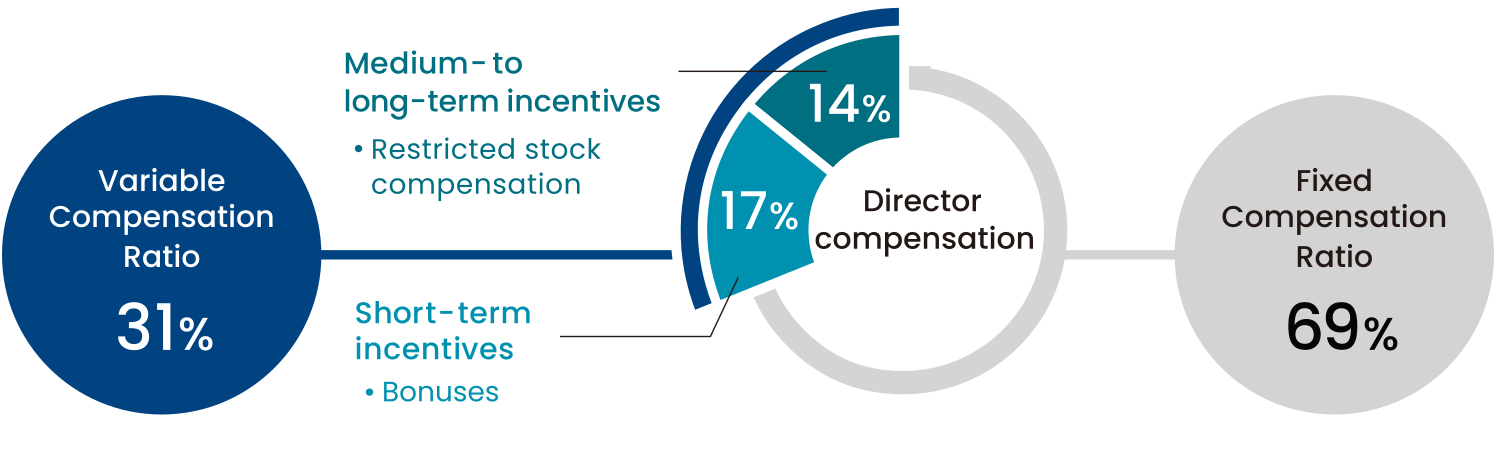
Percentages of basic compensation and incentives for directors (excluding outside directors) in fiscal 2024
Fixed Compensation
This will be paid as a fixed monthly amount. The execution, supervision, and representation portions of the fixed compensation for members of the board (excluding Member of the Board, Chairman) and Executive Officers are separated to strengthen governance and create a compensation structure that is easy to understand. The amounts paid for the supervision and representation portions are uniformly the same regardless of position. The amount of execution-related compensation varies depending on each position. In the case of the Chairman of the Board, such compensation is paid as fixed compensation.
Bonuses
The overview of the Bonus System is as described in the following table.
| Overview of the Bonus System | |
|---|---|
| Definition | Short-term incentive compensation to encourage the steady achievement of performance targets each fiscal year |
| Eligible Recipients | Directors (excluding the Chairman of the Board) and Executive Officers. |
| Performance Indicator | Core operating income, which is a key indicator in the VISION 2030 and the result of business activities. (Fiscal 2024 result: JPY 101.0 billion) |
| Formula (Underlined Portion) | Core operating income × coefficient × coefficient by position × ( evaluation coefficient for non-financial indicators + evaluation coefficient for performance of the division in charge ) Note: |
| Evaluation Indicators | Evaluation of non-financial indicators
|
Evaluation of the performance of the division in charge
| |
| Upper and Lower Profit Limit | From the perspective of compensation governance, and taking into account the control of excessive compensation payments compared to benchmarks and the responsibility to pay dividends to shareholders, the upper and lower profit limits for bonus payments are as follows. (The upper profit limit is the amount of profit at which the bonus amount reaches its maximum, and the lower profit limit is the amount of profit at which the bonus accrues) ・ Upper profit limit: Core operating income of ¥300 billion (set based on the VISION 2030 target) ・ Lower profit limit: Core operating income of ¥36 billion (set based on DOE) DOE: Ratio of distribution of equity attributable to owners of the parent company |
| Time of Payment | Paid once a year, within two business days after the date of the Annual General Meeting of Shareholders. |
Restricted Stock-Based Compensation
The restricted stock-based compensation is as described in the following table.
| Overview of the Restricted Stock-based Compensation System | |
|---|---|
| Definition | Medium- to long-term incentive compensation to encourage increased corporate and shareholder value |
| Eligible Recipients | Directors (including the Chairman of the Board) and Executive Officers |
| Performance Indicator | Since the purpose is to promote a shared awareness of profits with shareholders aimed at enhancing corporate and shareholder value, net income attributable to owners of the parent, which is a key indicator in the VISION 2030 and is linked to shareholder profits, is used. (Fiscal 2024 result: JPY 32.2 billion) |
| Formula (Underlined Portion) |
(( Net income attributable to owners of the parent × coefficient )× ROE evaluation coefficient )× coefficient by position × TSR evaluation coefficient
Note: |
| Evaluation Indicators | ROE evaluation ・ Reason for selection of the indicator: ・ The evaluation period is one fiscal year (from April to March of the following year), and the level of achievement of the budget for each fiscal year is evaluated. The evaluation is on a three-point scale, and the evaluation coefficient ranges from 110% to 90%. 【 Formula 】 ROE budget achievement rate = ROE actual value ROE budget value × 100 |
TSR evaluation ・ Reason for selection of the indicator: ・ The evaluation period is one fiscal year (April to March of the following year), and the Company’s TSR is evaluated relative to the TSR of the “JPX-Nikkei Index 400 including dividends,” which is the target for comparison. The evaluation is on a seven-point scale, and the evaluation coefficient ranges from 130% to 70%. 【 Formula 】 The Company’s TSR = ( Average closing price of the stock for each Relative TSR = ( The Company’s TSR TSR of the JPX-Nikkei Index 400 including dividends )× 100 Start period: April 1 to April 30 End period: March 1 to March 31 |
|
| Upper and Lower Profit Limit | From the perspective of compensation governance, and taking into account the control of excessive compensation payments compared to benchmarks and the responsibility to pay dividends to shareholders, the upper and lower profit limits for restricted stockbased compensation are as follows. (The upper profit limit is the amount of profit at which the restricted stock-based compensation amount reaches its maximum, and the lower profit limit is the amount of profit at which the restricted stock-based compensation accrues) ・ Upper profit limit: Net income attributable to owners of the parent of ¥200 billion (set based on the VISION 2030 target) ・ Lower profit limit: Net income attributable to owners of the parent of ¥22 billion (set based on DOE) DOE: Ratio of distribution of equity attributable to owners of the parent company |
| Period of Restriction on Transfer | Until the time of retirement or resignation from the position of an officer or employee of the Company predetermined by the Board of Directors such as member of the Board, Corporate Auditor, Executive Officer, Chief Senior Director, Senior Director, Councillor, Advisor, Senior Advisor, or employee of the Company, or any other similar position (hereinafter “Position of Restriction on Transfer”), |
| Release of Transfer Restrictions | All transfer restrictions on the shares shall be lifted, provided that the recipient has continuously held a position subject to transfer restrictions throughout the transfer restriction period. |
| Forfeiture without Compensation | If certain events occur, such as resignation or retirement from a position subject to transfer restrictions during the transfer restriction period without due cause (including expiration of term, death, or mandatory retirement), or engagement in business activities that compete with the Company’s business, the Company shall acquire all of the allocated shares without compensation. |
| Conditions of Payment | From the perspective of compensation governance, restricted stock-based compensation shall not be paid if the net income attributable to owners of the parent is below the lower limit set based on the dividend on equity attributable to owners of the parent company (DOE). |
| Time of Payment | Paid once a year, in July. |
Total Compensation for Fiscal 2024
| Classification | Total Compensation (Millions of yen) | Total Compensation by Type (Millions of yen) | Number of Persons Applicable | ||
|---|---|---|---|---|---|
| Fixed Compensation | Bonuses | Stock Compensation | |||
| Members of the Board (excluding outside directors) | 428 | 296 | 72 | 60 | 5 |
| HASHIMOTO Osamu | (138) | (78) | (37) | (23) | – |
| Corporate auditors (excluding outside auditors) | 72 | 72 | – | – | 3 |
| Outside directors and outside corporate auditors | 96 | 96 | – | – | 7 |
| Total | 596 | 464 | 72 | 60 | 15 |
Notes:
1. | The figures in the table above include amounts paid to one Director and one Corporate Auditor who retired upon the conclusion of the Company’s 27th Annual General Meeting of Shareholders held on June 25, 2024, as well as to one Corporate Auditor who retired in February 2025, covering the period from April 2024 through to their respective dates of retirement. |
2. | Figures in parentheses are included in the figures in the line above. |
Capability of the Board of Directors as a Whole and Views on Diversity
- The number of members of the board of MCI will be 12 or less, as stipulated in the Articles of Incorporation, and the appropriate number within that range will be decided at each opportunity in consideration of the status of authorities delegated to executive officers and the need to streamline decision making in response to business expansion. MCI will select in principle independent outside members of the board at a ratio of one third or more of the total members in order to appropriately reflect the opinions of individuals from outside MCI with rich experience and insight, such as corporate managers, academics, and legal professionals, in the management policies of MCI and to increase the effectiveness of the oversight of operations by members of the board.
- MCI will select members of the board in consideration of the specific characteristics of our businesses and without regard for gender, race, nationality, or other such factors so that the members of the board as a whole possess balanced business experience in areas including business planning, operations, production and technology, research and development, accounting and finance, and general, personnel, and legal affairs. Furthermore, in addition to the above principle, MCI shall also select individuals who have corporate management experience in other companies as independent outside members of the board.
Outside Directors and Outside Corporate Auditors
Mitsui Chemicals believes that management’s accountability and transparency is best served by obtaining opinions from independent outside directors and corporate auditors at meetings of the Board of Directors. The Company also believes that appropriate decision making at meetings of the Board of Directors is made possible by obtaining advice from persons with specialized knowledge.
To ensure that these objectives are achieved, the content of materials presented at Board of Directors meetings is explained to outside directors and outside corporate auditors in advance. In addition, the Company provides newly elected outside directors and outside corporate auditors with opportunities to deepen their understanding of the Company’s business. These opportunities include explanations of the Company’s business activities and tours of business locations.
When selecting candidates for outside directors and outside corporate auditors, the Company considers each individual based on the selection criteria set out in the Company’s Corporate Governance Guidelines. Moreover, all the outside directors and outside corporate auditors of the Company not only satisfy the selection criteria but also meet the criteria for independence set by the financial instruments exchange and the Independence Standards for Independent Outside Directors and Independent Outside Corporate Auditors provided as an Appendix to the Company’s Corporate Governance Guidelines. All the outside directors and outside corporate auditors also put themselves in the position of a stakeholder, and provide beneficial and candid advice regarding improving the corporate value of the Mitsui Chemicals Group. As outside directors and outside corporate auditors have no risk of a conflict of interest with general shareholders, even from a practical standpoint, the Company regularly submits a notice to the Tokyo Stock Exchange to this effect stating that all its outside directors and outside corporate auditors are independent officers. Furthermore, there are no special interests between the Company and any of its outside directors and outside corporate auditors.
Major Activities of Outside Members of the board and Attendance at Meetings of the Board of Directors and Board of Auditors(FY2024)
| Major Activities of the Board of Directors and Board of Auditors | Attendance at Meetings of the Board of Directors and Board of Auditors | ||
|---|---|---|---|
| Board of Directors (Total Number of Meetings Held: 16) | Board of Auditors (Total Number of Meetings Held: 20) | ||
| Outside Directors | |||
MABUCHI | He primarily speaks about sound and efficient corporate management from the point of view of one concerned with the validity of business execution while taking proactive measures to identify issues and risks based on his extensive experience as a corporate manager and his in-depth knowledge about the mobility field. | 16/16 | – |
MIMURA | He primarily speaks about sound and efficient corporate management from the point of view of one concerned with the validity of business execution while taking proactive measures to identify issues and risks based on his extensive experience as a corporate manager, his experience as chairman of the industry association, and his in-depth knowledge about the healthcare field. | 15/16 | – |
| KIHARA Tami | She primarily speaks about sound and efficient corporate management from the point of view of one concerned with the validity of business execution, based on her experience as a corporate manager and her in‑depth knowledge cultivated through leading digital talent strategies at listed companies, as well as her expertise in diversity and information security. | 13/14 | – |
| Outside Corporate Auditors | |||
SHINBO | Until stepping down due to his passing on February 8, 2025, he spoke about sound and efficient corporate management from the perspective of one concerned with ensuring that the execution of the Company’s business is appropriate, based on his specialist knowledge and extensive experience not only as a lawyer but also as an outside officer of other companies, while providing timely views aimed at enhancing the supervisory function of the Board of Directors. | 10/12 | 12/15 |
GOTOH | She speaks about sound and efficient corporate management from the perspective of one concerned with ensuring that the execution of the Company’s business is appropriate based on her extensive experience as her experience of serving important roles in national and local government agencies, and her wealth of experience having served as manager and CFO of a listed company, as well as her experience as an outside officer of other companies. | 16/16 | 19/20 |
ONO | He speaks about sound and efficient corporate management from the perspective of one concerned with ensuring that the execution of the Company’s business is appropriate based on his extensive experience as a certified public accountant over many years. | 16/16 | 20/20 |
Note:
In addition to the above number of Board of Directors meetings, there was one written resolution that was deemed to have been approved by the Board of Directors pursuant to Article 370 of the Companies Act and Article 24 of the Company's Articles of Incorporation.