Mitsui Chemicals, Lawson Break New Ground in Convenience Store Industry With "Bio & Circular" Initiative
Natural Lawson begins offering plastic bags made from Prasus™, a brand of chemically recycled and bio-based polyethylene made using the mass balance approach
2026.01.23
Mitsui Chemicals, Inc.
Prime Polymer Co., Ltd.
Mitsui Chemicals, Inc. (Tokyo: 4183; President & CEO: HASHIMOTO Osamu) announced today that the Prasus™ line of bio-based and chemically recycled polyethylene produced and sold by Prime Polymer Co., Ltd. (Chuo-ku, Tokyo; President & CEO: YOSHIZUMI Fumio), a Mitsui Chemicals Group company, has been adopted for plastic bags offered at Natural Lawson stores operated by Lawson, Inc. (Tokyo: 2651; President & CEO: TAKEMASU Sadanobu).
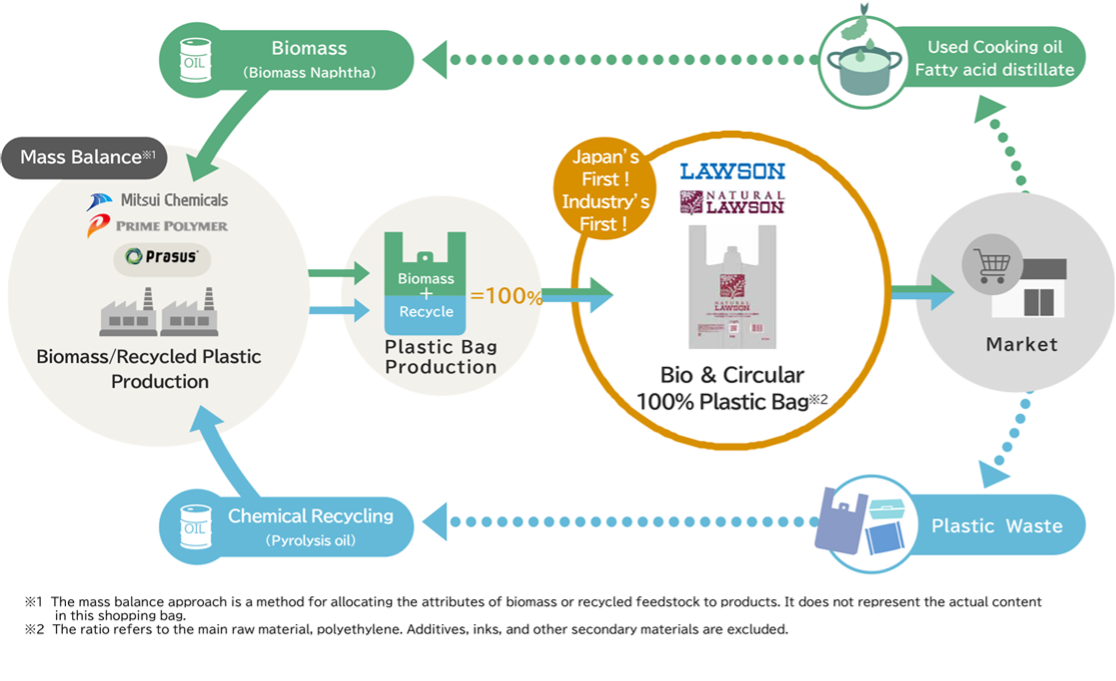
Starting from January 2026, Lawson will roll out bags made with Prasus™, which incorporates both bio-based polyethylene and recycled polyethylene allocated under the mass balance approach, as their sole main material. The rollout will begin with certain stores, with plans to eventually bring these bags to all Natural Lawson stores.
This initiative will be the convenience store industry’s first to adopt bags made using a combination of bio-based and recycled polyethylene produced under the mass balance approach
* Dedicated webpage from Lawson (Japanese only):
https://natural.lawson.co.jp/sp/campaign/detail/1512650_5475.html
* Dedicated webpage from Mitsui Chemicals (Japanese only):
https://jp.mitsuichemicals.com/jp/sustainability/beplayer-replayer/case/lawson/index.htm
* Both of the above webpages will launch on January 27.
Environmental issues surrounding plastics
Plastics are linked to two key environmental issues: global warming and plastic waste. The Earth's temperature is predicted to increase by 5.7°C by the year 2100*1, and Japan alone generates as much as 7.69 million tons of plastic waste per year*2.
While Japan has a high recycling rate for plastic waste – 89 percent – thermal recycling accounts for 64 percent of this figure. Consequently, while this plastic waste is used as an effective source of heat and fuel, the fact that it is incinerated rather than reused as a material, which leads to CO2 emissions*3.
Out of plastic containers and packaging collected separately in line with the Containers and Packaging Recycling Act, approximately 45 percent is recycled through conventional methods*4. In other words, while about half of this plastic waste is recycled into new materials, the other half is put toward means such as thermal recycling (not to be used as resource for recycled plastic), resulting in CO2 emissions. This highlights the fact that a shift toward bioplastics – rather than relying entirely on recycling – will be essential to avoid increasing CO2 in the atmosphere.
Additionally, the use of a new technology known as chemical recycling has made it possible to recycle more plastic waste in recent years. This approach can result in materials that offer the same quality and safety as conventional petrochemical-based plastics – and as a result, chemical recycling has been attracting attention as a technology that can help to further improve society’s overall rate of recycling.
*1 JCCCA materials on the IPCC Sixth Assessment Report (Japanese only): https://www.jccca.org/download/43044
*2 Plastic Waste Management Institute (Japanese only): https://www.pwmi.or.jp/pdf/panf1.pdf
*3 Plastic Waste Management Institute (Japanese only): https://www.pwmi.or.jp/column/column-2566/
*4 3Rs Promotion Council (Japanese only):https://www.3r-suishin.jp/PDF/2024Report/Followup_Report2024_all.pdf
A new kind of plastic bag realized through "Bio & Circular"
Lawson and Mitsui Chemicals have collaborated to develop these new plastic bags as part of a “Bio & Circular” initiative to highlight and address some of the issues surrounding plastics. Made with a mixture of bio-based and chemically recycled polyethylene as their sole main material, these bags will help to reduce the consumption of new fossil resources, increase the recycling rate via the reuse of plastic waste as a resource, and cut CO2 emissions – the key cause of global warming – by 36 tons per year*5.
Both Lawson and Mitsui Chemicals are committed to leveraging biomass and recycling approaches alike in the effort to reduce environmental impact and move toward a regenerative future.
*5 Upon full rollout across all Natural Lawson stores.
What is the mass balance method (material balance method) ?
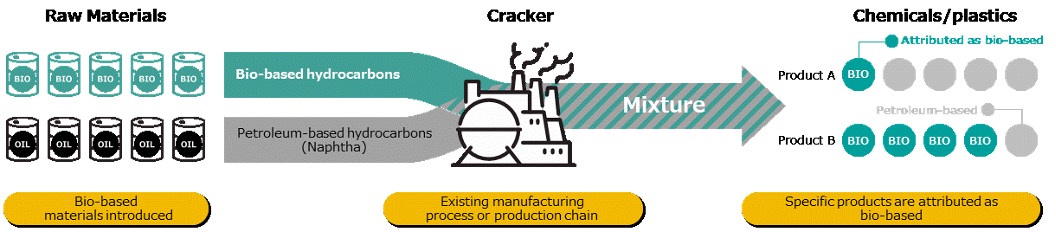
The Ministry of the Environment’s Roadmap for Bioplastics Introduction defines the mass balance approach as “A method in which, during the process of turning raw materials into final products and the distribution process (chain of custody), raw materials with certain properties (e.g., bio-based raw materials) are mixed with raw materials that do not have the properties (e.g., fossil-based raw materials); thus, the properties are assigned to a portion of the product according to the amount of input of the raw materials with those properties.”
The physical properties of plastics and chemical products made under the mass balance method do not differ whatsoever from their fossil-derived counterparts. The mass balance method also allows for the use of biomass and recycled feedstocks in materials where it has traditionally been difficult. As a result, the mass balance method is an important means of increasing society’s adoption of biomass and recycled resources and realizing a carbon-neutral and a circular-economy society.
The Mitsui Chemicals Group has already employed the mass balance approach to incorporate biomass and recycled feedstocks across approximately 50 product groups (as of January 2026).
Prasus™

The brand name for Prime Polymer’s line of environmentally friendly, sustainable polyethylene and polypropylene made from novel feedstocks under the mass balance approach.