Biomass Plastics Based on the Mass Balance Approach Adopted for Toshiba Industrial Products and Systems’ Molded Transformers
2026.05.27
Mitsui Chemicals, Inc.
Mitsui Chemicals, Inc. (Tokyo: 4183; President & CEO: ICHIMURA Satoshi) is expanding its lineup of bio-based hydrocarbon derivatives – including biomass chemicals and biomass plastics – under the BePLAYERTM brand, as part of its efforts to promote the use of biomass throughout society in order to help address climate change.
Mitsui Chemicals’ biomass plastics based on the mass balance approach have now been adopted for various plastic parts used in molded transformers compliant with 2026 Top Runner standards manufactured and sold by Toshiba Industrial Products and Systems Corporation (Kawasaki, Kanagawa; President & CEO: ITO Wataru), as well as for coils in extra-high-voltage molded transformers. Mitsui Chemicals is contributing to this initiative through the provision of raw materials as part of the supply chain*.
This initiative represents a practical example of efforts aimed at achieving carbon neutrality across the entire value chain, in line with Toshiba Group’s Environmental Future Vision 2050. In addition to addressing environmental considerations from a functional perspective by complying with the third phase of Japan’s Top Runner standards, the new energy efficiency standards for transformers that came into effect in April 2026, the initiative also promotes the use of biomass plastics in products.
Transformers require extremely high performance in terms of long-term durability, safety and efficiency. In this context, biomass plastics based on the mass balance approach play an important role in making products greener while maintaining high performance, as their physical properties are equivalent to those of conventional petroleum-derived products.
*Mitsui Chemicals’ contribution involves switching to biomass-based raw materials in its production of epoxy resins and polycarbonate resins.
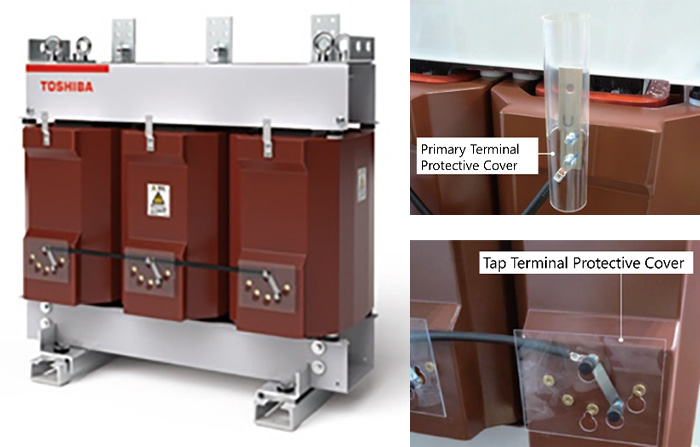
Biomass polycarbonate resin adopted for various plastic parts in 2026 Top Runner molded transformers
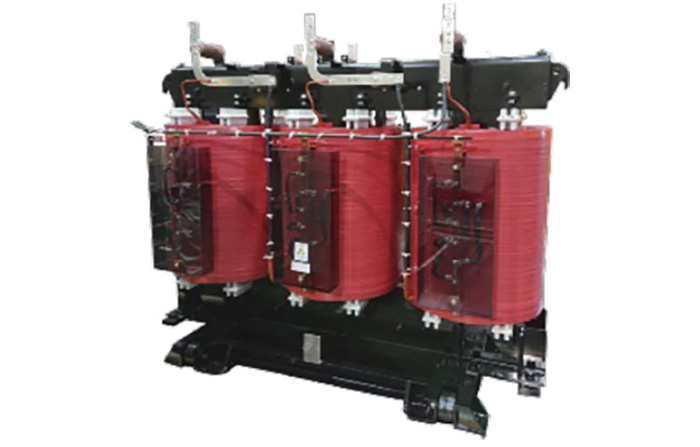
Biomass epoxy resin adopted for coils in extra-high-voltage molded transformers
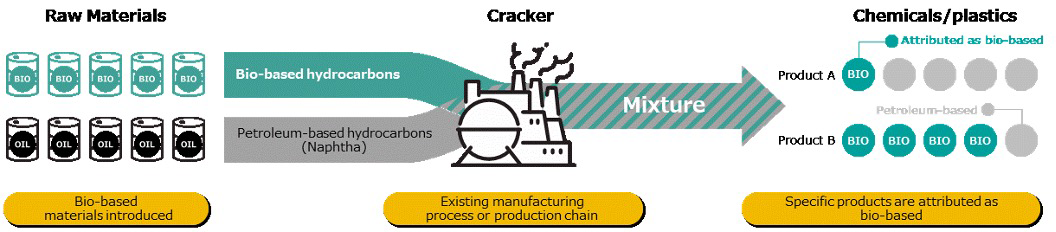
The mass balance approach
The Ministry of the Environment’s Roadmap for Bioplastics Introduction defines the mass balance approach as “A method in which, during the process of turning raw materials into final products and the distribution process (chain of custody), raw materials with certain properties (e.g., bio-based raw materials) are mixed with raw materials that do not have the properties (e.g., fossil-based raw materials); thus, the properties are assigned to a portion of the product according to the amount of input of the raw materials with those properties.”
The physical properties of plastics and chemical products made under the mass balance method do not differ from their fossil-derived counterparts. The mass balance method also allows for the use of biomass in the production of materials where it has traditionally been difficult. Therefore, the mass balance method is a significant means of increasing the adoption of biomass in society and realizing a carbon neutral society. As of June 2025, around 50 product groups across the Mitsui Chemicals Group have already switched to the use of biomass resources based on the mass balance approach. Mass balance also has a crucial role to play in chemical recycling, which is being rolled out as a recycling solution that will pave the way for a circular economy. Here, too, the Mitsui Chemicals Group offers plastics and chemical products derived from chemical recycling in around 50 product groups.
BePLAYER™

Under BePLAYERTM, we will help the transition to bio-based society to solve the problem of climate change. We will further the development of bio-based products via the mass balance and segregation methods alike, along with other products and technologies contributing to carbon neutrality, in an effort to substantially assist in reducing society’s greenhouse gas emissions.