Chemicals Working Group Demonstrates Collaborative Rail Freight, Confirming Feasibility of Continuous Round-Trip Operations With Same Container
Modal shift achieves 57% reduction in CO₂ emissions, significantly cuts driver hours
2026.03.24
Mitsui Chemicals, Inc.
The Chemicals Working Group (Chairman: Professor YANO Yuji, Ryutsu Keizai University) of the Physical Internet Realization Council – a body led by the Ministry of Economy, Trade and Industry (METI) and the Ministry of Land, Infrastructure, Transport and Tourism (MLIT) – conducted a demonstration test from August 2025 to January 2026 aimed at realizing collaborative logistics via rail freight in the Tokai and Chugoku regions.
The test found that collaborative rail freight by multiple shippers is feasible, with the potential for continuous round-trip operations using the same container. This modal shift demonstrated significant positive effects, including a 57% reduction in CO2 emissions.
The Chemicals Working Group currently includes 86 companies and 1 university, most of them consignors and logistics providers, and sees participation from the Japan Chemical Industry Association, the Japan Petrochemical Industry Association, and several relevant divisions from METI and MLIT, among other bodies. Mitsui Chemicals, Inc., Mitsubishi Chemical Corporation, Tosoh Corporation and Toray Industries, Inc. serve as the Group’s joint secretariat.
For further information, please see the following materials.
■ References
- July 29, 2025: Industry Group Launches Collaborative Logistics Demonstration Test Using Rail Transport in Tokai and Chugoku Regions in Effort to Solve Logistics Issues in Chemical Industry
https://jp.mitsuichemicals.com/en/release/2025/2025_0729/index.htm
- June 25, 2025: Physical Internet Realization Council’s Chemicals Working Group Reported the FY 2025 Action Policy
https://jp.mitsuichemicals.com/content/dam/mitsuichemicals/sites/mci/documents/release/2025/250625e.pdf
- December 23, 2024: Physical Internet Realization Council’s Chemicals Working Group Runs Demonstration Test to Find Effects of Joint Logistics
https://jp.mitsuichemicals.com/content/dam/mitsuichemicals/sites/mci/documents/release/2024/241223_1e.pdf
- June 11, 2024: Physical Internet Realization Council’s Chemicals Working Group to Conduct Demonstration Test for Joint Logistics in the Kanto–Tokai Region
https://jp.mitsuichemicals.com/content/dam/mitsuichemicals/sites/mci/documents/release/2024/240611.pdf (Japanese only)
- June 13, 2023: Establishment of a Chemicals Working Group in the Physical Internet Realization Council
https://jp.mitsuichemicals.com/content/dam/mitsuichemicals/sites/mci/documents/release/2023/230613e.pdf
Physical Internet Realization Council
Chemicals Working Group
Chemicals Working Group Demonstrates Collaborative Rail Freight, Confirming Feasibility of Continuous Round-Trip Operations With Same Container
Modal shift achieves 57% reduction in CO₂ emissions, significantly cuts driver hours
The Chemicals Working Group*1 of the Physical Internet Realization Council*2 – a body led by the Ministry of Economy, Trade and Industry (METI) and the Ministry of Land, Infrastructure, Transport and Tourism (MLIT) – is pursuing cooperation between participating companies across the chemical industry to address a range of logistics issues that are difficult for individual companies to solve on their own. These issues include shortages in transport and storage capacity, which typify what has been called the “2024 Problem” for Japan’s logistics industry.
As members of the Chemicals Working Group, Mitsubishi Chemical, Tosoh, Mitsui Chemicals, JR Freight and Nippon Express conducted a demonstration test from August 2025 to January 2026 to realize collaborative logistics via rail freight. Conducted between the Tokai and Chugoku regions of Japan, the test used freight stations in Nagoya, Aichi on one end, and Hiroshima City and Otake, Hiroshima on the other end, as relay points in a plan to improve chemical transport capacity through a modal shift.
The test found that collaborative rail freight by multiple shippers is feasible, with the potential for continuous round-trip operations using the same container. This modal shift demonstrated significant positive effects, including a 57% reduction in CO2 emissions.
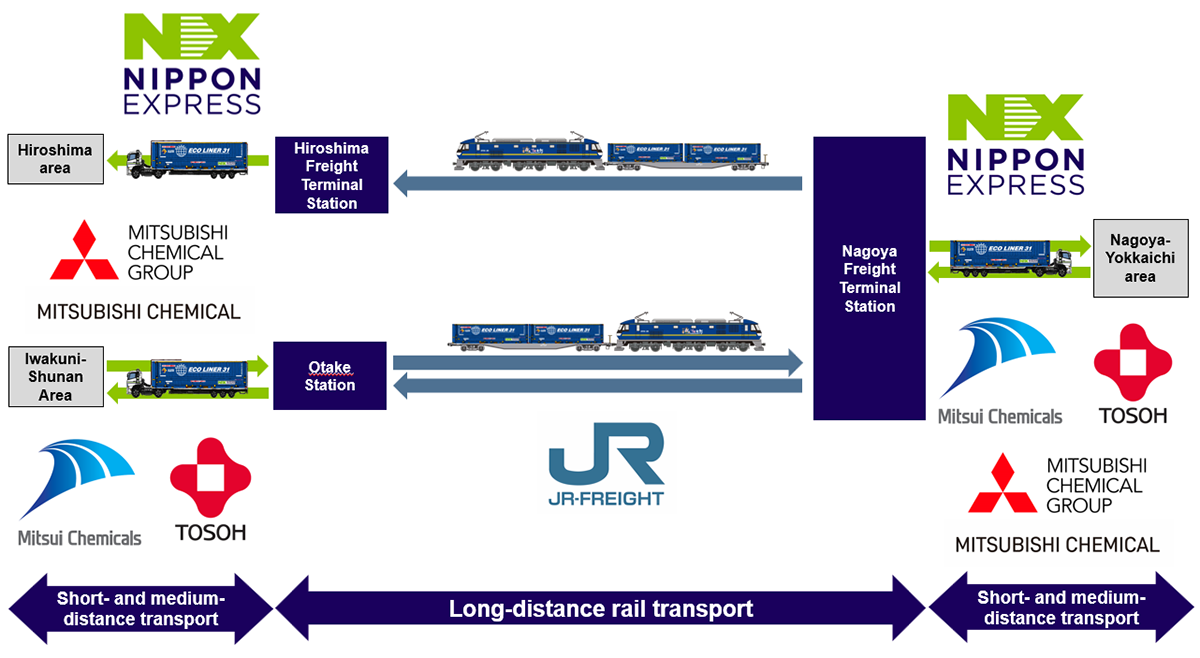 Overview of the scheme
Overview of the demonstration test
Test period:
August 2025 – January 2026
Overview of the initiative:
Status quo trial
Each company operated its own transport routes individually to identify operational and procedural issues.
Round-trip trial
The companies ran continuous round-trip services across their respective routes using the same container.
Theoretical trial
The companies prepared operational workflows for practical implementation, developed evaluation criteria that also considered switches to alternative transport, and created a transport calendar based on past performance to confirm the optimal shipping schedule.
Results and issues from the demonstration test
Verification that collaborative rail freight among multiple shippers and multiple logistics providers
– an unprecedented effort in the chemicals industry – is feasible
The test confirmed that three shippers can use the same container to operate continuous round-trip transport.
- Quantitative evaluation of the modal shift effect achieved through rail freight
KPI Effect CO2 emissions 57% reduction Truck transport distance 74% reduction
Truck driver work hours
64% reduction
Select issues to overcome in order to build a standard scheme for collaborative logistics using 31-foot containers
The test was conducted with practical implementation in mind, combining actual freight runs with simulated testing to develop a standard scheme that accounts for transport delays and other irregularities. However, it also became clear that there are several issues to address before these schemes can be implemented:
- 1) When transporting cargo in 31-foot containers, available freight stations are limited by location constraints, which lengthens the drayage distance (land transport from the freight station to the delivery destination by large trailer) and in turn prevents operators from fully realizing the quantitative benefits of rail freight. A key focus should therefore be on developing a scheme centered on freight stations that can handle 31-foot containers.
- 2) Unlike the more general-purpose 12-foot containers, 31-foot containers are privately owned, with use predicated on round-trip operations. It will be essential as such to secure stable cargo for both outbound and return trips to keep container utilization high, which in turn will require the establishment of a new framework. Besides finding suitable cargo, challenges here will include dealing with a complex set of measures on the shipper side, such as leveling cargo volumes and relaxing logistics constraints.
Schedule for future efforts
The following efforts are planned to address the two challenges listed above:
- 1) Explore further options for 20-foot containers, as only a limited number of freight stations are capable of handling 31-foot containers.
- 2) Look to secure return cargo through various matching services and other means, both within and outside the industry.
The broader Chemicals Working Group will meanwhile proceed with implementing the voluntary action plan announced in December 2023. It is hoped that, by working to build a sustainable logistics model that takes into account the government’s ongoing logistics innovation measures and new modal shift initiatives, the Group will contribute to the sustainability of Japan’s chemical industry.
*1 Chemicals Working Group
Chairman: Professor YANO Yuji, Ryutsu Keizai University (Dean, Faculty of Distribution and Logistics Systems; President, Japan Logistics Society)
Participants include 87 organizations (86 companies and 1 university, as of the end of February 2026), mainly shippers and logistics companies, as well as the Japan Chemical Industry Association, the Japan Petrochemical Industry Association, and relevant divisions of METI and MLIT.
(Announced December 20, 2023): Voluntary action plan to streamline logistics and improve productivity for chemical products
https://www.cas.go.jp/jp/seisaku/buturyu_kakushin/jk_pdf/28.pdf (Japanese only)
*2 Physical Internet Realization Council
An organization established by METI and MLIT in October 2021 to formulate a roadmap for achieving a physical internet in Japan.
https://www.meti.go.jp/shingikai/mono_info_service/physical_internet/index.html (Japanese only)
■ References
- July 29, 2025: Industry Group Launches Collaborative Logistics Demonstration Test Using Rail Transport in Tokai and Chugoku Regions in Effort to Solve Logistics Issues in Chemical Industry
https://jp.mitsuichemicals.com/en/release/2025/2025_0729/index.htm