
日本語 English

Risk Management

Management System

Policy and Basic Approach

Risks are becoming more complex as uncertainty in the business environment increases, such as worsening climate change, geopolitical conflicts and tensions, and global epidemics of infectious diseases. Under these circumstances, the Mitsui Chemicals Group operates a Group-wide risk management system from a medium- to long-term perspective and on an ongoing basis, seeking to minimize the threats posed by risks while fully capitalizing on every opportunity, thereby achieving sustainable growth and enhancing corporate value over the medium- to long-term. We assess the risks we face from both financial and non-financial perspectives with reference to VISION 2030 and material topics, and designate key Group-wide risks. Risks determined to be particularly material and requiring cross-Group management are designated as key business risks* and managed across the Group. For these risks, we conduct regular monitoring, and effectively implement the PDCA cycle in light of changes in the internal and external environment.

* The term “key business risks” was referred to as “most important risks” in fiscal 2024 and “priority risks” in fiscal 2025 before being renamed “key business risks” in fiscal 2026. For consistency, “key business risks” is used throughout this section.

System and Responsible Officers

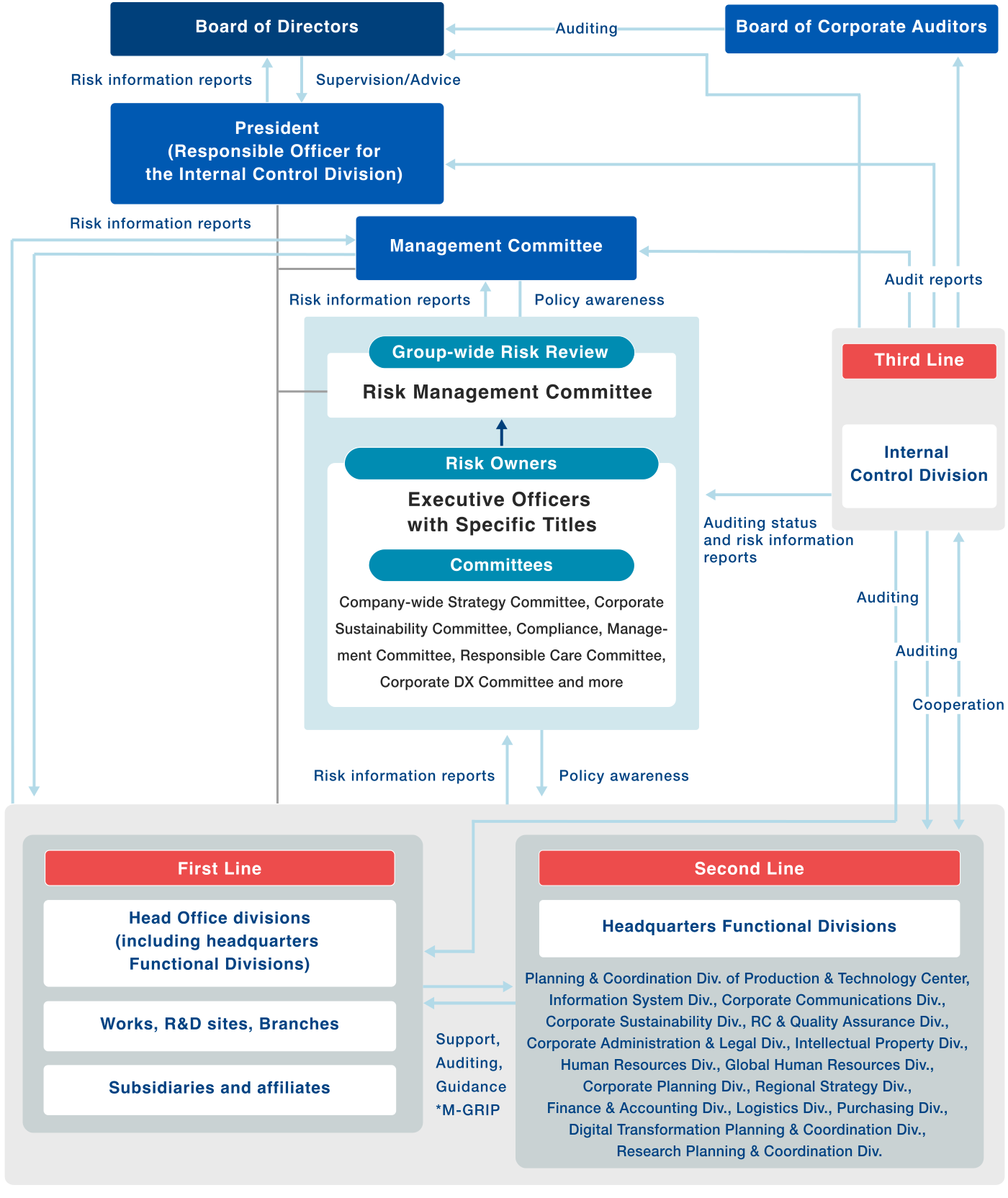
The Board of Directors is responsible for the development and supervision of the overall risk management system of the Mitsui Chemicals Group. Under the supervision of the Board of Directors, the President assumes the ultimate responsibility for the risk management of the entire Group, while the Risk Management Committee general manager oversees the Group-wide risk management system and its implementation.

In addition, the President and Risk Management Committee general manager  shall establish a “Risk Management Committee” as a specialized committee for risk management of the entire Group.

As a risk owner, each executive officer with a specific title is responsible for overseeing risk management in the business areas under their jurisdiction and responsibility, and executes risk management by utilizing the various committees (Corporate Sustainability Committee, Compliance Management Committee, Responsible Care Committee and Corporate DX Committee, etc.) and other committees under their control (Company-wide Strategy Committee, investment deliberation meetings, etc.).
First Line

The head of each division (Head Office divisions, Works, R&D sites, Branches, and Affiliates) and the head of the headquarters division in charge are responsible for the day-to-day risk management, under the responsibility of an executive officer with a specific title who is the risk owner of their own line. Specifically, they identify and assess risks based on the risk model, appropriately identify risks, and design and implement organizational controls to address those risks. They also supervise and provide guidance on risk management at affiliates under their jurisdiction.

Second Line

In order to ensure that each division manages risks, the heads of headquarters functional divisions with expertise in their areas of responsibility support the risk management of first-line-of-defense divisions, their own divisions, and affiliates from a professional standpoint, under the responsibility of executive officers with specific titles who are their own risk management owners. They also implement Group-wide risk management measures in the relevant area.

Third Line

The Internal Control Division independently audits operations in both the first and second lines and provides assurance to top management and the Board of Directors. The Internal Control Division conducts business audits and responsible care audits to maintain and strengthen the level of internal control in the Mitsui Chemicals Group and works to keep existing business risks at an acceptable level. At the same time, the Division conducts continual inspections and assessments of the design and operation of internal controls relating to financial reporting for the entire Mitsui Chemicals Group, as required under the Financial Instruments and Exchange Act, as the J-SOX assessment as a part of the statutory audit and directs its efforts to ensuring the correct and efficient execution of operations. The audit results are regularly reported directly to the Board of Directors and the Board of Corporate Auditors.

The business audit includes an internal audit process based on self-assessment of internal controls utilizing the compliance checklist. The compliance checklist includes items related to compliance with the antimonopoly act, the SME transactions act, the worker dispatch act, prevention of bribery, insider trading and harassment, compliance with the securities export control regulations, appropriate handling of corporate and personal information, human rights, information systems security, risk management, credit management, fair accounting and tax administration, and organization and operation of appropriate internal controls. The checklist is revised every year. As process owners for each of the above items, the headquarters functional divisions are audited on the state of their operations. Additionally, audits are conducted based on topics selected each fiscal year from the risk status both in and outside the organization.

From among the responsible care audits (environment & safety audit, occupational health audit, quality audit, and chemical safety audit), the Internal Control Division is responsible for executing the environment & safety audit and the occupational health audit. The Internal Control Division also audits quality audit and chemical safety audit conducted by the headquarters functional divisions to determine whether they have been executed appropriately. We conduct audits primarily on-site. However, from the perspectives of operational efficiency and business continuity planning (BCP), we have a system in place that allows us to conduct audits remotely when necessary.

Risk Management System

Risk Management System

*M-Grip:
The abbreviation of “Mitsui Chemicals - Global Risk Management & Business Support Improvement Platform”.

Role of the Risk Management Committee

  • Deliberation of proposed basic policies, strategies, plans, measures for our Group-wide risk management and other important issues related thereto (including measures to improve risk management processes and tools and raise awareness and literacy regarding risk management among employees)
  • Deliberation of key Group-wide risks (draft) through Group-wide risk review
  • Discussion of individual key important risks (including discussions on the impact that each of the individual risks have on our Group and policies for handling such risks)
  • Report on and discussion of the status of our Group-wide risk management

Composition of the Risk Management Committee

ChairPresident
Vice ChairRisk Management Committee general manager
Members*Executive officers with specific titles (Risk management owners)
SecretariatCorporate Planning Division (Collaboration among the Corporate Sustainability Division, Corporate Administration & Legal Division, Human Resources Division, Finance and Accounting Division, Production & Technology Planning Division, RC & Quality Assurance Division and headquarters functional divisions designated by the Risk Management Committee general manager)

* The full-time Audit & Supervisory Board Members also attend meetings of the Risk Management Committee and provide comments as appropriate.

Risk Management Process

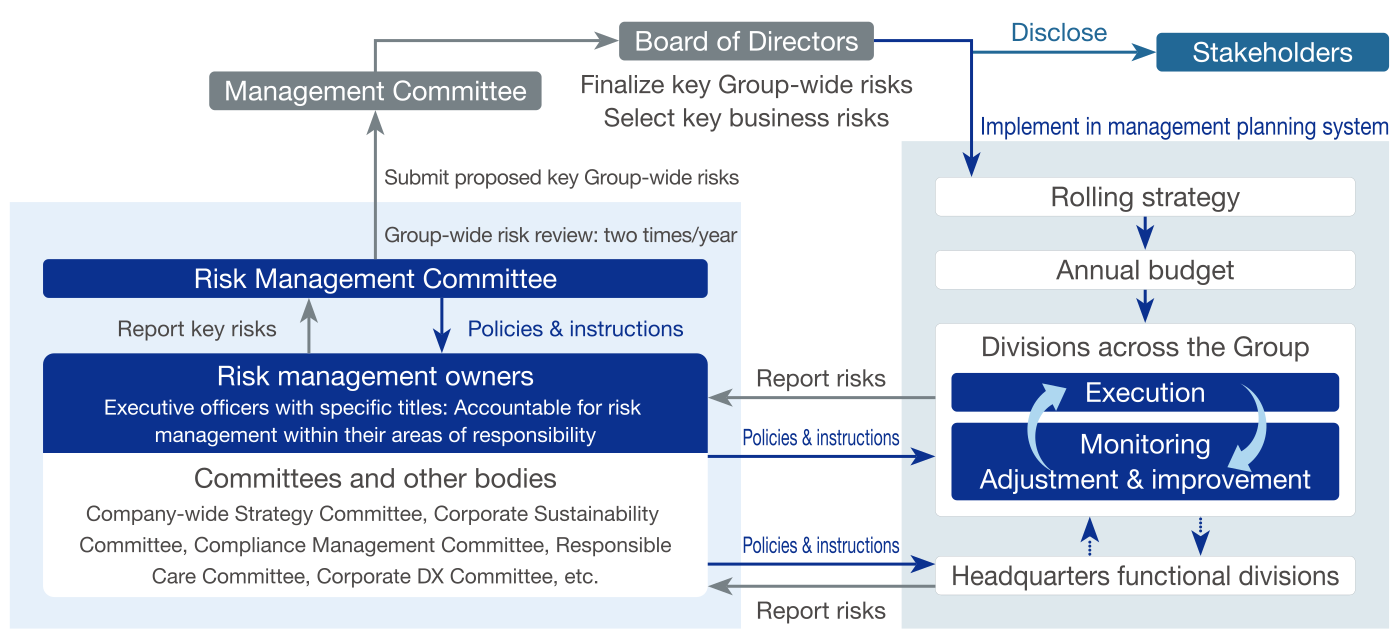
We deploy the aforementioned risk management system throughout the Group, and identify "key Group-wide risks" that require precise implementation of the PDCA cycle in the management planning system. These key Group-wide risks together with the series of processes involving confirmation and improvement of the status ("Group-wide risk review") are to be set twice a year in accordance with the following procedures:

  1. Each risk owner (executive officer with specific title) shall extract risks in the business areas under their control through the rolling strategic plans*, understand and prioritize them comprehensively and thoroughly, and report to the Risk Management Committee on risks that are deemed to be of Group-wide importance.
  2. The Risk Management Committee shall evaluate the materiality of risks reported by each risk owner by long-term, medium-term, and short-term from a bird's-eye view and comprehensive perspective, and formulate a draft report on key Group-wide risks.
  3. Key Group-wide risks (draft) are deliberated by the Management Committee and determined as key Group-wide risks by resolution of the Board of Directors.
  4. The key Group-wide risks established shall be rolled out across the Group's business plan system, including rolling strategic plans, annual budgets, action plans, among other things, and they are practiced by each division under the responsibility of each risk owners.
  5. The Risk Management Committee shall consistently monitor the key Group-wide risks and take timely measures to, for example, respond to changes in risk as a result of environmental changes.

*Rolling strategic plans:

Review of business plans for the next three years to be conducted annually based on the long-term business plan

リスクマネジメントプロセス

M-GRIP, a Platform for Globally Strengthening Governance of Affiliates and Sharing Best Practices

With the goals of reducing the risks that have grown as globalization accelerates and of further transforming and expanding the business of the Mitsui Chemicals Group, in fiscal 2020 we began deploying the Mitsui Chemicals Global Policy Platform (M-GRIP), which is a shared indirect operations platform for the Group. M-GRIP is the mechanism that lays out Global Policies (G/Ps) comprising measures that are common to the entire Group regarding indirect operations such as human resources, accounting, and logistics. By ensuring that each company within the Group implements those measures, it allows the execution of proper business operations and ongoing improvements. It is also intended to support the activities of affiliates through the effective use of the Group’s economies of scale. In July 2026, we established new G/P for crisis management. As a result, we have counted 19 G/Ps since rolling this out in FY2020, and are steadily moving toward establishment. By fostering a common awareness throughout the Group and supporting sustainability management and thorough crisis management, which helps improve corporate value, we aim to realize a corporate group that enjoys sustainable growth by working to reduce and avoid risk and improve business efficiency.

Global Policies (G/Ps) Developed to Date
Established G/P FieldYear Established
Compliance with Competition Laws
Position Management
Procurement Operations
Logistics Management
Transportation and Storage of Dangerous Goods
Idle Cash Management
Information System Security
Quality Management
Chemicals Management
FY2020
Authorization
Anti-Bribery
Information Security
Protection of Personal Information
Governance of Group Company Officers
FY2021
Environmental Preservation and Occupational Safety Management
Security Export Control Regulation
Insider Trading Management
FY2022
Group Compliance ManagementFY2023
Crisis managementFY2026

M-GRIP Deployment Chart

The headquarters functional divisions, the regional headquarters, the affiliates, and the Affiliates Coordination Division are working together, each playing its respective role.

M-GRIP展開チャート

Response to the Occurrence of Risks

The Mitsui Chemicals Group has established a crisis management framework based on the Crisis Management Regulations and related company rules to prepare for situations in which risks materialize into actual crises. When a crisis occurs—whether within the Group or at an affiliated company—the division where the crisis originated promptly contacts the relevant divisions designated in advance, depending on the type of crisis.

The relevant divisions then hold discussions and, based on predefined criteria and the need for a cross-functional response, submit a proposal to the President regarding the establishment of a crisis response headquarters. If the President decides to establish the headquarters, a company-wide response is swiftly initiated to bring the situation under control. Even in cases where a response headquarters is not established, we have put in place committees where relevant divisions share information, consider, and promote countermeasures, with a system that enables transition to a full-scale response headquarters depending on the situation.

* Examples of potential crisis types include:

Disasters at plants or other facilities, accidents involving product quality or safety, legal violations, outbreaks of infectious diseases.

Basic Principles of Crisis Response (as Defined in the Crisis Management Regulations)

  • Respect for human life, and consideration for safety and the environment
  • Consideration for local communities
  • Compliance with social norms