
日本語 English

Sustainable Procurement

Supplier Evaluation and Guidance for Improvement

Mitsui Chemicals Group Sustainable Procurement Guidelines

The Mitsui Chemicals Group has compiled the “Mitsui Chemicals Group Sustainable Procurement Guidelines” to outline the items we ask our suppliers to work on together with us from the perspective of sustainable procurement. We request the cooperation for our suppliers based on these guidelines. To further promote sustainable procurement in collaboration with our suppliers, we strengthened the implementation of the guidelines in April 2025. Initially, we are asking domestic suppliers to sign an agreement and to cooperate in disseminating the guidelines to their subcontractors.

Transaction Procedures

When initiating transactions with new suppliers of key raw materials, we share the Guidelines and verify the suppliers' efforts toward achieving a sustainable society through their responses to the Sustainable Procurement Survey. For ongoing suppliers, we regularly review their efforts according to the nature of the business relationship. In addition to items related to environmental conservation, occupational safety, and quality assurance, we also have specific check items that cover a wide range of topics, including corporate governance, fair trade, human rights, and information security.

Based on the results of these reviews, we evaluate the partner companies, using the findings not only to decide on partner selection and the continuation of business relationships but also to offer guidance on making improvements where needed.
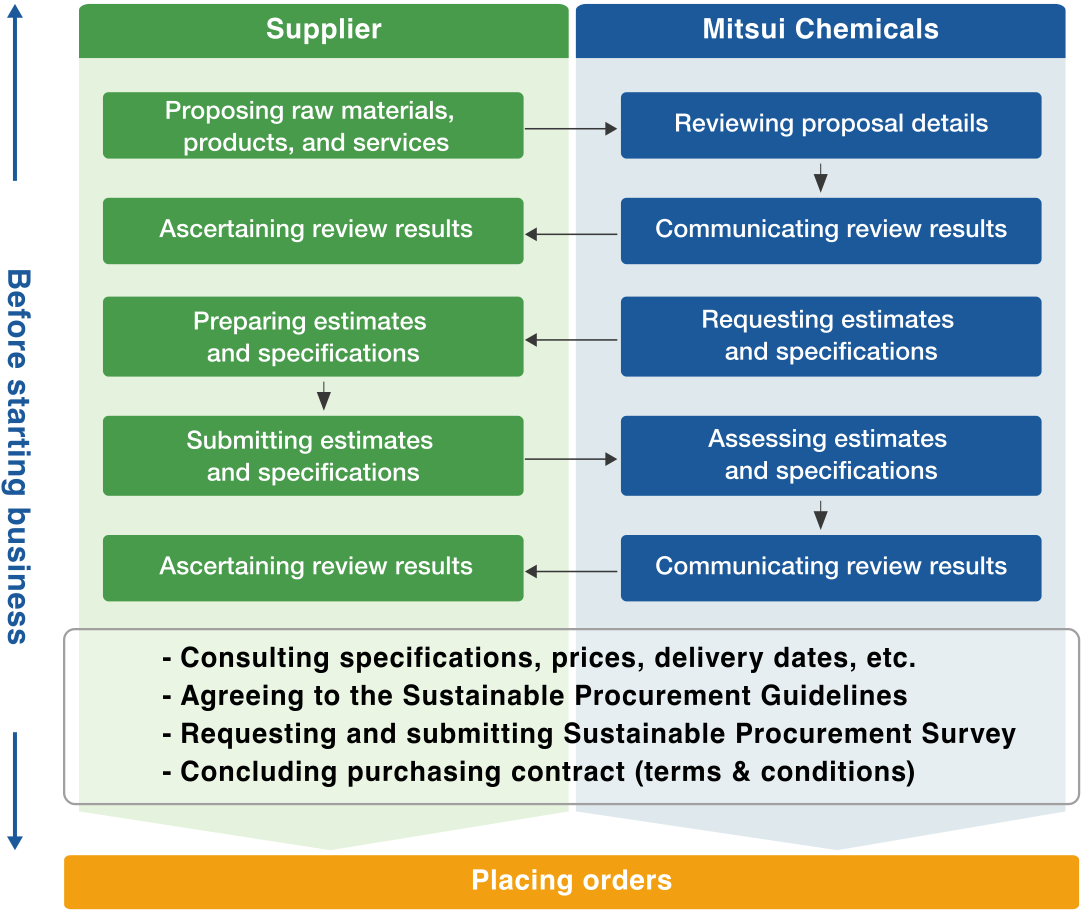
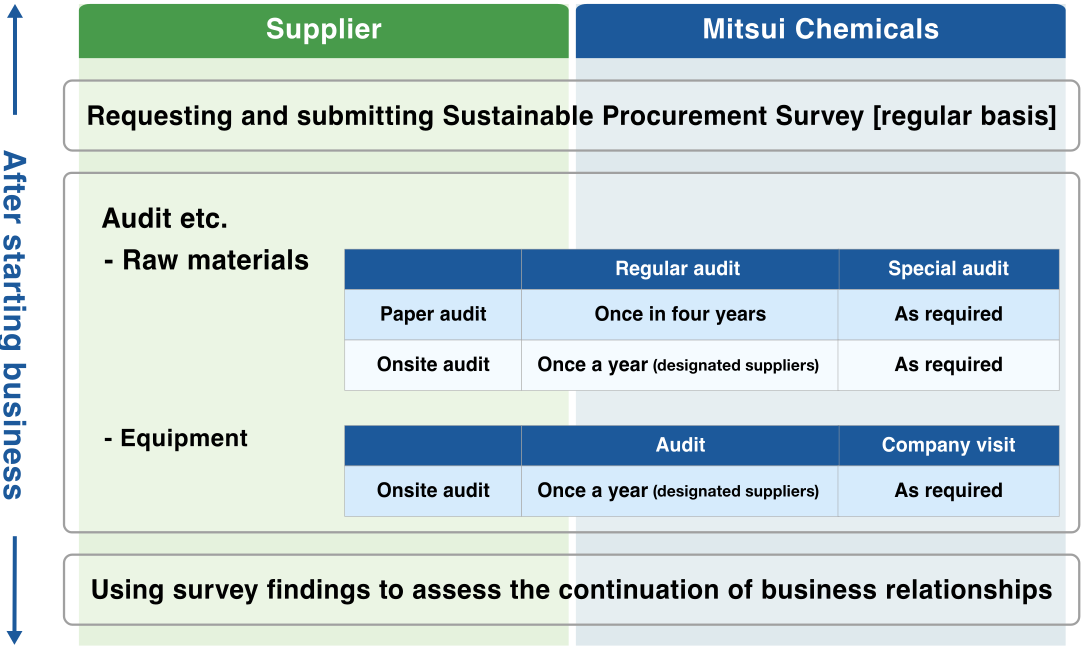
Transaction Procedures

Operational Process

Supplier Agreement

To enhance the effectiveness of initiatives under the Mitsui Chemicals Group Sustainable Procurement Guidelines, we strengthened our operational processes in April 2025 and began requesting domestic suppliers to sign an agreement form. In addition, we seek their cooperation in promoting awareness and implementation of the Guidelines among their subcontractors, thereby aiming to improve sustainability performance across the entire supply chain.

Supplier Assessment

The Mitsui Chemicals Group conducts a sustainable procurement survey of its suppliers to identify environmental, social, and governance (ESG) issues within its supply chain.

The survey results are analyzed and assessed by the purchasing division and are used as a basis for decisions regarding supplier selection and the continuation of business relationships. The results also serve as the foundation for follow-up activities aimed at encouraging improvement.

KPI and Progress

The Sustainable Procurement Ratio (KPI) for FY2025 is disclosed based on initiatives undertaken by Mitsui Chemicals, Inc. only. In FY2025, we requested the cooperation of 345 suppliers in completing the sustainable procurement survey and received responses from all of them.

This KPI visualizes, on a transaction value basis, the response status of suppliers participating in the sustainable procurement survey.

While our reporting has previously included major domestic affiliates, differences remain among companies in terms of survey methodologies and the maturity of operational practices. Therefore, we will first standardize operations by aligning survey content, procedures, and evaluation criteria, and then gradually expand disclosure to cover the Mitsui Chemicals Group as a whole.

Sustainable procurement ratio = Transaction values with suppliers who responded to the sustainable procurement survey / Total transaction value

ScopeFY2025FY2026 (Goals)FY2030 (Goals)
Mitsui Chemicals Group

67%

(Mitsui Chemicals, Inc. only)

70%80%

Improvement Follow-up

Based on the results of the sustainable procurement survey, we provide support for suppliers identified as having room for improvement by sharing issues and discussing improvement measures through on-site visits and direct dialogue.

This follow-up process is not intended as a one-sided evaluation. Rather, it emphasizes two-way communication with suppliers and aims to enhance sustainability across the entire supply chain.

In FY2025, we conducted a pilot improvement follow-up through an interview-based approach with one supplier. From FY2026 onward, we will roll out the program more broadly by combining face-to-face interviews with written follow-up letters.

Roadmap for Expanding Coverage

The Mitsui Chemicals Group aims to establish a unified sustainable procurement framework across the Group and implement evaluation and monitoring based on common standards. To achieve this, we are first working to standardize survey content, operational procedures, and evaluation criteria, and will then gradually roll out the framework to domestic and overseas affiliates.

In addition, the progress of initiatives undertaken by participating companies will be incorporated into our KPIs, enabling integrated management across the Group.

Through these efforts, we will expand the scope of supplier surveys and assessments while improving efficiency by preventing duplicate surveys. At the same time, we will enhance the objectivity and comprehensiveness of our evaluations.

Looking ahead, we will visualize sustainable procurement performance across the Mitsui Chemicals Group and ultimately expand disclosure of the Sustainable Procurement Ratio on a Group-wide basis.

Planned Number of Companies for Rollout = Number of affiliates scheduled to begin implementation in the relevant fiscal year (estimated)

CategoryFY2026FY2027FY2028FY2029FY2030FY2031
Domestic subsidiaries and affiliates4/24 companies14/24 companies24/24 companies───
Overseas subsidiaries and affiliates──4/33 companies14/33 companies24/33 companies33/33 companies

Policy on Conflict Minerals

The Mitsui Chemicals Group has established a policy of not purchasing or using raw materials containing conflict minerals, in accordance with the Mitsui Chemicals Group Sustainable Procurement Guidelines.

The Purchasing Division and the  RC & Quality Assurance Division worked together to identify raw materials subject to investigation, such as tin catalysts, based on the composition information of products registered in the chemical safety information system.

For raw materials identified as subject to investigation, mineral sourcing surveys are conducted using the CMRT and EMRT* reporting templates. Similar surveys are also carried out for other raw materials in response to customer requests.

In our sustainable procurement survey, we also include questions regarding suppliers' measures to address conflict minerals and strive to ensure appropriate management throughout the supply chain.

The Mitsui Chemicals Group is committed to responsible mineral sourcing by confirming through these surveys that minerals associated with conflict, human rights abuses, or similar concerns are not purchased or used.

Should the use of any such minerals be identified in the future, we will take corrective actions and promote initiatives to eliminate their use.

* CMRT:
Conflict Minerals Reporting Template. Conflict Minerals Reporting Template provided by the Responsible Minerals Initiative (RMI) for submitting reports on conflict minerals.

* EMRT:

Extended Minerals Reporting Template, a reporting template for extended minerals developed and provided by the Responsible Minerals Initiative (RMI).

Building a Digital Transformation (DX) Foundation to Support Sustainable Procurement

The Mitsui Chemicals Group is developing a procurement platform as part of its digital transformation (DX) initiatives to serve as a foundation for achieving sustainable procurement.

This platform centrally manages information related to supplier agreements, survey responses, and assessment results, as well as ESG, compliance, product quality, and business continuity planning (BCP). It also enables the efficient and continuous operation of key processes, including supplier surveys and assessments. 

Through these efforts, we are advancing the visualization of the entire supply chain while enhancing our risk management capabilities. In addition, by utilizing external assessment information and other resources, we ensure the objectivity of our evaluations and promote more effective sustainable procurement practices.

Going forward, we will continue to improve the effectiveness of sustainable procurement and enhance sustainability across the entire supply chain by leveraging digital technologies to further standardize and streamline our operations.

Education and Awareness

The Mitsui Chemicals Group continuously conducts internal education and awareness-raising activities, primarily for Purchasing Division personnel, to promote the implementation of sustainable procurement. In addition, we provide explanations on our sustainable procurement initiatives and survey programs to purchasing personnel in business divisions and domestic affiliates. We also require Purchasing Division personnel to complete e-learning programs on sustainable procurement to enhance their knowledge and understanding.

Supplier Risk and Compliance

The Mitsui Chemicals Group provides suppliers with information on important sustainability and compliance principles and key considerations, with the aim of achieving sustainable development for both our suppliers and the Group.

As major risk areas associated with business transactions, we address topics such as compliance with laws and regulations, human rights and labor practices, environmental management, fair trade and anti-corruption, and information security. From the perspective of risk prevention and mitigation, we communicate our expectations and points of attention to suppliers.

Specifically, we have promoted greater awareness and understanding of risks through initiatives such as holding briefing sessions for contractors working at our production sites, sharing case studies of past incidents and non-conformities, explaining requirements and expectations related to business transactions, and distributing risk awareness materials. These documents are also distributed on a regular basis to ensure ongoing awareness and communication.

In addition, we provide information on whistleblowing and reporting channels, thereby helping to establish an environment that enables the early identification and correction of issues.

Through these initiatives, we seek to deepen dialogue and mutual understanding with our suppliers while enhancing risk management across the entire supply chain and strengthening its integrity and reliability.